In high-vacuum applications, a silicone hose must do more than provide a flexible connection. It needs to maintain its internal flow path when exposed to negative pressure, temperature changes, vibration, and repeated operating cycles. A conventional silicone hose may deform or collapse if its wall structure cannot withstand the external pressure acting on it.
A wire reinforced silicone hose is designed to address this challenge. By incorporating metal wire into the silicone rubber structure, the hose gains additional resistance to vacuum-induced collapse while retaining flexibility for installation in confined spaces. For automotive systems and other demanding equipment, choosing the right reinforcement structure is essential to maintaining reliable performance.
SUNRISE specializes in custom silicone hose manufacturing, including spring wire reinforced designs for high-vacuum applications. This guide explains how wire reinforcement works, what engineers should consider during hose selection, and how to specify a hose for a particular operating environment.
When a hose operates under vacuum, the pressure inside the hose is lower than the surrounding atmospheric pressure. This pressure difference creates an external compressive force on the hose wall. If the hose structure lacks sufficient resistance, its cross-section may become oval, deform, or collapse.
This problem is particularly important in automotive vacuum lines, engine-related air systems, and equipment where consistent airflow or vacuum transmission is required. A collapsed hose can restrict flow, reduce system efficiency, and affect the operation of connected components.
Standard silicone rubber offers flexibility and good resistance to temperature extremes, but flexibility alone does not guarantee resistance to vacuum collapse. The hose needs an appropriate structural reinforcement that helps it retain its shape under the specified operating conditions.
A wire reinforced silicone hose combines the flexibility of silicone rubber with the structural support of metal wire. This construction makes it suitable for applications where an ordinary silicone tube may not provide sufficient resistance to external pressure.
The key function of wire reinforcement is to provide mechanical support against deformation. Instead of relying entirely on the silicone rubber wall to maintain its cross-sectional shape, the embedded metal wire helps resist inward deformation when the hose is exposed to vacuum.
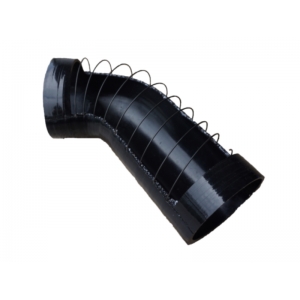
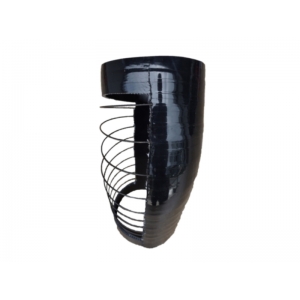
Spring wire is commonly used in flexible vacuum hose designs because its elastic properties help the hose retain its shape while allowing bending and movement. The wire reinforcement acts as a supporting structure within the silicone hose, reducing the risk of inward wall deformation under negative pressure.
Unlike a rigid metal pipe, a spring wire reinforced silicone hose can accommodate curved routing and movement within an equipment assembly. This is useful in automotive engine compartments, where available installation space is limited and hose connections may experience vibration.
The silicone rubber provides the flexible sealing body, while the embedded wire contributes structural stability. The performance of the finished hose depends on how these materials work together, including wire diameter, winding pitch, reinforcement position, silicone wall thickness, and the overall hose geometry.
Reinforcement should therefore be considered as part of the complete hose design rather than as an additional component selected independently of the rubber material.
Wire material is an important consideration when designing a reinforced silicone hose. SUNRISE offers wire reinforcement options including spring steel and stainless steel. The appropriate choice depends on the required flexibility, mechanical performance, surrounding environment, and service conditions.
| Selection factor | Spring steel wire | Stainless steel wire |
|---|---|---|
| Primary consideration | Elastic recovery and structural support | Corrosion resistance and environmental compatibility |
| Flexibility | Suitable for flexible spring structures | Depends on alloy, wire diameter, and construction |
| Environmental conditions | Requires consideration of corrosion protection | Useful where moisture or corrosion exposure is a concern |
| Typical selection priority | Elasticity and mechanical support | Corrosion resistance and service environment |
There is no universally better wire material for every application. For example, a vacuum hose installed in a relatively dry engine compartment may prioritize spring performance and flexibility. An application exposed to moisture or corrosive surroundings may require stainless steel wire, with the appropriate grade selected according to the environment.
When requesting a custom hose, buyers should communicate the operating environment and expected service life rather than specifying the wire material based on one characteristic alone.
Choosing a suitable hose requires more than matching the inside diameter of an existing connection. Engineers and purchasing teams should evaluate the complete operating conditions to avoid deformation, leakage, and premature failure.
Start by identifying the actual vacuum level in the system. Vacuum specifications may be expressed as absolute pressure, negative gauge pressure, or a percentage of vacuum. These values should be clearly distinguished when communicating with a hose manufacturer.
Also consider whether the hose experiences continuous vacuum, intermittent vacuum, or sudden pressure fluctuations. A hose designed for moderate negative pressure may not be suitable for a system operating close to full vacuum.
For reliable selection, request the manufacturer's available vacuum performance data and confirm the test conditions, including temperature, hose dimensions, and test duration.
The inner diameter determines the connection size and contributes to the flow characteristics of the system. The outer diameter and wall thickness affect installation clearance, mechanical strength, and the space available for reinforcement.
Increasing wall thickness may improve resistance to deformation in some constructions, but it can also increase hose stiffness and affect the minimum bending radius. The dimensions and reinforcement design should be evaluated together.
Vacuum hoses are often routed around engine components, brackets, and other equipment. A hose that resists collapse but cannot accommodate the required bend may create installation difficulties or excessive stress at the connection points.
Check the minimum bending radius, hose routing direction, connection angles, and available clearance. For complex assemblies, a custom-shaped hose may provide a better fit than a straight tube.
Temperature affects the mechanical behavior of both silicone rubber and metal reinforcement. The selected silicone compound should maintain suitable flexibility and physical properties throughout the actual operating temperature range.
Engine compartments, industrial equipment, and other high-temperature environments may expose hoses to continuous heat as well as short-term temperature peaks. Buyers should provide both the normal operating temperature and the maximum expected temperature when requesting a quotation.
It is also important to check compatibility with any oil, fuel, coolant, cleaning agent, or other media that may contact the hose. Standard silicone rubber is not automatically suitable for every chemical or hydrocarbon exposure.
Even a well-designed vacuum hose can experience leakage if the connection is unsuitable. Consider the fitting diameter, insertion depth, clamp position, sealing surface, and potential movement during operation.
For assemblies involving metal connectors or special connection structures, manufacturers may also provide customized silicone hose solutions with integrated metal parts. The connection design should be evaluated alongside the hose body to ensure reliable installation.
Wire reinforced silicone hoses are used in systems where flexibility and resistance to vacuum-induced deformation are both important. Their applications are not limited to one vehicle type or equipment category.
Automotive vacuum systems may require flexible hoses to connect different components within a limited engine compartment. Reinforced silicone hose designs can help maintain the hose shape when negative pressure and engine vibration occur together.
Applications may include vacuum connections and other engine-related air routing systems, subject to the specific media and operating requirements.
Heavy-duty vehicles often involve complex hose routing, limited installation space, and continuous vibration during operation. A flexible reinforced hose can help accommodate movement while providing additional structural support against vacuum-related deformation.
For these applications, the hose design should account for vehicle operating conditions, connection geometry, temperature exposure, and maintenance requirements.
Industrial equipment may require flexible connections between vacuum sources, ducts, and mechanical assemblies. Wire reinforcement can be considered where a flexible silicone connection needs additional resistance to inward deformation.
However, the suitability of silicone depends on the conveyed medium, pressure conditions, temperature, and chemical exposure. For applications involving aggressive chemicals, fuels, or oils, a specially formulated or lined hose may be more appropriate.
Wire reinforcement and textile braiding serve different structural purposes. Although both are reinforcement methods, they should not be treated as interchangeable when selecting a hose for vacuum applications.
| Feature | Wire reinforced hose | Braided silicone hose |
|---|---|---|
| Reinforcement | Embedded metal wire | Textile reinforcement |
| Main design focus | Resistance to vacuum-induced collapse | Pressure handling and dimensional stability |
| Flexibility | Depends on wire geometry and hose construction | Depends on braid structure and hose design |
| Typical application consideration | High-vacuum connections | Reinforced liquid and air transfer |
For applications involving internal pressure and fluid transfer, a reinforced silicone hose with textile braiding may be a suitable option. For high-vacuum service where inward collapse is the main concern, a dedicated wire reinforced construction should be evaluated first.
The correct reinforcement method depends on the direction of the applied pressure and the performance requirements of the system, not simply on the number of reinforcement layers.
Standard hose dimensions do not always match the requirements of specialized automotive and industrial assemblies. Different equipment designs may require unique diameters, curved configurations, reinforcement materials, or connection structures.
SUNRISE has manufactured performance silicone hoses and molded silicone products since 2006. The company provides customized silicone hose manufacturing for automotive, railway, mechanical equipment, electronics, and other industrial applications.
For high-vacuum requirements, SUNRISE offers wire reinforced silicone hoses using spring steel or stainless steel wire. The design can be evaluated according to the customer's drawings, samples, and operating conditions.
When developing a customized hose, the following information helps the manufacturer assess the design more accurately:
Customers can provide technical drawings or physical samples for evaluation. SUNRISE also offers customized hose development for special configurations and complex applications.
To explore the available product specifications, visit the custom wire reinforced silicone hose for high-vacuum applications.
A successful hose selection starts with a clear description of the application. Instead of asking only for a high-vacuum silicone hose, provide the manufacturer with the operating parameters and installation requirements.
For example, an automotive equipment buyer may need a flexible silicone hose with a specific inner diameter, a curved routing path, spring steel wire reinforcement, and resistance to continuous negative pressure. These details help the manufacturer determine whether the proposed construction is suitable and whether a customized design is necessary.
It is also advisable to request relevant performance information, including vacuum resistance under defined test conditions, temperature capability, dimensional tolerances, and material specifications. Where the application is safety-critical or performance-sensitive, prototype evaluation under actual operating conditions is recommended.
For customized solutions, contact SUNRISE with your drawings, samples, or technical requirements. The engineering team can review the application and help identify a suitable wire reinforced silicone hose construction.
A wire reinforced silicone hose is a flexible silicone rubber hose incorporating metal wire within its structure. The wire provides additional mechanical support, helping the hose resist deformation and collapse when exposed to high vacuum conditions.
Under vacuum, external atmospheric pressure can compress a hose wall when internal pressure is lower. Wire reinforcement helps maintain the hose cross-section, reducing the risk of collapse and flow restriction.
Common options include spring steel wire and stainless steel wire. Spring steel is selected for its elastic properties and structural support, while stainless steel may be preferred where corrosion resistance is an important requirement. The final choice depends on the application environment and design.
Yes. SUNRISE manufactures custom wire reinforced silicone hoses according to customer drawings, samples, and application requirements. Customization can include hose dimensions, wire material, reinforcement construction, color, and hose configuration.
It can be designed for continuous vacuum applications, but suitability depends on the actual vacuum level, temperature, hose dimensions, reinforcement structure, and operating duration. The required vacuum performance should be confirmed with the manufacturer through defined specifications and testing.

Sunrise Silicone Hose Co., Limited


عنوان : Suite 805, No. 341 Jiahe Road, Xiamen City, Fujian Province, China
بريد الالكتروني : sales@siliconehose-china.com