Choosing a manufacturing process is one of the first decisions in custom silicone hose development. A straight tube, a reinforced coolant hose, and a hose with a bend or special connection often call for different processes.
This guide explains how silicone extrusion and silicone compression molding work, how they differ, and how to choose between
extruded silicone hose and molded silicone hose designs.
Key Takeaways
-
Silicone extrusion produces continuous tubing and profiles with a consistent cross-section.
-
Compression molding forms individual parts inside heated mold cavities, so it suits shaped components.
-
Extrusion generally suits straight or long tubing. Compression molding generally suits elbows, bends, and formed connections.
-
Tooling cost, order volume, geometry, and reinforcement all affect the choice.
-
The final process should be confirmed against the actual product drawing and operating conditions.
What Is Silicone Extrusion?
Silicone extrusion is a continuous process that produces tubing and profiles with a defined cross-section. Solid silicone rubber is fed into an extruder and forced through a specially designed die. The extruded material is then vulcanized to develop its final rubber properties.
How Does the Extrusion Process Work?
1. Compound preparation: The silicone compound is prepared to meet the required hardness, color, and application.
2. Extrusion and shaping: A screw conveys and compresses the compound and pushes it through the die. For hollow tubing, the tooling also forms the inner passage.
3. Continuous vulcanization: The extruded profile passes through a curing system. The method and conditions depend on the compound and equipment.
4. Cooling and cutting: The cured tube is cooled, inspected, and cut to length.
The die controls the cross-section, so its design directly affects inner diameter, outer diameter, and wall thickness. Stable material flow and curing also help maintain consistent dimensions along the length.
Where Is Extruded Silicone Hose Used?
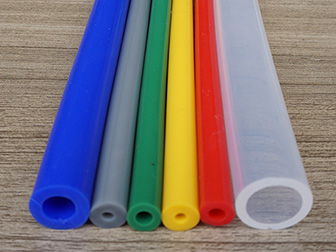
Extruded silicone hose suits applications where the cross-section stays the same along its length. It can be produced in a range of diameters, wall thicknesses, and colors.
Typical extruded silicone hose applications include automotive vacuum lines, where flexibility and resistance to collapse matter. Industrial silicone tubing is another common use.
For example,
Sunrise’s industrial tubing has a recommended working temperature of -65°F to 482°F (-54°C to 250°C) according to its product specifications. However, actual limits depend on the specific compound and application, so confirm them for your project.
What Is Silicone Compression Molding?
Silicone compression molding forms rubber parts inside a heated mold. The manufacturer places a measured piece of uncured silicone compound into the mold cavity. The mold closes under pressure, the compound fills the cavity, and heat cures it.
How Does Compression Molding Work?
1. Material preparation and loading: A preform of uncured silicone is prepared and placed into the cavity.
2. Compression and heating: The mold closes under controlled pressure and temperature, and the compound fills the cavity.
3. Vulcanization: The material cures inside the mold.
4. Demolding and finishing: The part is removed, trimmed if needed, and inspected against the drawing.
The cavity defines the shape. Material quantity, venting, and curing conditions all influence the finished part.
How Does It Relate to Hose Production?
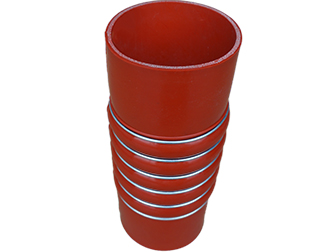
Compression molding is used for formed silicone parts and for hose designs whose geometry can be shaped in a mold, such as elbows, reducers, and hoses with defined connection geometry.
For example, molded radiator and heater hoses for cooling systems need specific routing and can include polyester or aramid reinforcement.
Not every shaped hose is made this way. Some designs use injection molding or hand-built construction. Ask the manufacturer which process applies to your specific design.
Compression Molding vs Injection Molding
Both are molding processes, but they differ in how material enters the mold.
Compression molding places the compound directly into the cavity. Injection molding, including liquid silicone rubber (LSR) injection, injects material into a closed mold.
Injection molding is generally better for complex shapes and higher volumes, while compression molding often needs simpler tooling. Manufacturers that offer both can match the process to the part.
How Do the Two Processes Compare?
Factor
|
Silicone Extrusion
|
Compression Molding
|
Cross-section
|
Consistent along the length
|
Defined by the mold cavity
|
Product form
|
Continuous profile, cut to length
|
Individual part
|
Typical shapes
|
Straight tubing, profiles
|
Elbows, bends, formed connections
|
Length
|
Flexible, cut to order
|
Limited by mold size
|
Tooling
|
Extrusion die and internal tooling
|
Product-specific mold
|
Tooling investment
|
Usually lower for standard profiles
|
Depends on part and cavity count
|
Best fit
|
Long, uniform tubing
|
Shaped parts with defined geometry
|
Neither process alone determines pressure resistance, flexibility, or service life. Those depend on the full construction: compound, dimensions, reinforcement, and curing quality.
How Do Materials and Reinforcement Affect the Choice?
Most solid silicone hoses use High Consistency Rubber (HCR), a solid compound often associated with HTV silicone. Suitable HCR grades can be extruded or compression molded, but processing and curing requirements differ.
-
For extrusion: The compound must flow through the die and keep its profile before vulcanization.
-
For compression molding: The compound must fill the cavity evenly under pressure.
Reinforcement is a construction choice, not a separate process. Common options include:
-
Polyester fabric for many automotive and industrial hoses.
-
Aramid fabric for constructions with different thermal requirements.
-
Wire reinforcement for added structural support.
-
Steel rings for demanding vacuum or pressure conditions.
Reinforcement placement affects flexibility, dimensions, and which manufacturing route is feasible.
How to Choose a Process for Your Hose
Start with the product design, then check the process.
1. Geometry: A tube with a constant cross-section is usually a candidate for extrusion. A part with bends, reducers, or formed ends usually points toward molding.
2. Dimensions: Review inner diameter, outer diameter, wall thickness, and tolerances together.
3. Reinforcement: Decide early whether you need polyester, aramid, wire, or steel rings.
4. Operating conditions: Define temperature, working pressure, vacuum, media, and installation space. A vacuum line and a coolant hose have different structural needs even when both are silicone.
5. Volume and tooling: Compare tooling investment with expected order quantity and the number of design variants.
As a rule of thumb, straight or long hose runs lean toward extruded silicone hose, and shaped hoses lean toward molding. The final choice should rest on whether the process can meet your complete specification.
Custom Silicone Hose Manufacturing
As a silicone hose manufacturer, SUNRISE produces silicone hoses, extruded tubing, and molded silicone products for automotive, railway, industrial equipment, healthcare, and other uses.
When choosing a supplier, look beyond the process name. Check tooling capability, material options, reinforcement methods, and experience with your hose construction.
Have questions about silicone extrusion or compression molding? Welcome to contact SUNRISE!
Frequently Asked Questions
What causes dimensional variation in extruded silicone tubing?
Inconsistent material flow, die conditions, curing stability, and cooling can all contribute. Good tooling design and process control help hold inner diameter, outer diameter, and wall thickness.
Does reinforcement change whether a hose can be extruded?
Yes. Some reinforced constructions can be made with specialized extrusion processes, while others need different production methods. It depends on the reinforcement material and the design.
Are molded silicone hoses and compression-molded silicone hoses the same?
No. "Molded silicone hose" is the broader category. Compression molding is one method within it, and injection molding or hand-built construction may also be used for shaped hoses.
When should I choose compression molding over extrusion?
Choose it when the hose has bends, reducers, or formed connection geometry that a constant cross-section cannot provide.