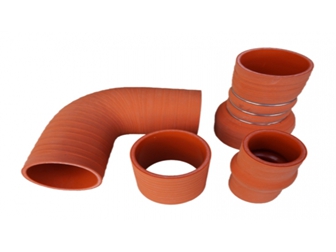
High-temperature engine environments can place demanding conditions on hose systems. Heat from the engine, turbocharger and nearby exhaust components may occur together with boost pressure, vibration, movement and limited installation space. Choosing a hose based on temperature alone can therefore lead to an unsuitable construction.
For B2B buyers and engineers, the selection process should consider the complete operating environment: temperature, pressure, medium, reinforcement, hose geometry and installation conditions. The right silicone hose is not simply the one with the highest temperature rating, but the one whose construction matches the actual application.
Key Takeaways
-
Match the hose to both continuous and peak temperature conditions.
-
Reinforcement affects pressure resistance, flexibility and dimensional stability.
-
Turbo and exhaust-related applications require attention to heat, pressure and surrounding components.
-
Complex engine layouts may require specially shaped or reinforced hose constructions.
What Makes a Hose Suitable for High-Temperature Engine Applications?
Engine compartments can expose hoses to different types of heat. A hose may be heated by the medium flowing through it, by surrounding engine components, or by nearby exhaust components.
This means the actual temperature requirement should be evaluated at the hose location rather than estimated only from the general engine operating temperature.
A
high temp silicone hose may be selected for applications involving elevated temperatures, but its reinforcement and construction still need to match the mechanical conditions. SUNRISE offers multi-layer fiberglass constructions and 4-ply to 5-ply aramid reinforced designs for demanding high-temperature and high-boost applications, with certain aramid constructions rated up to approximately 510°F (265°C).
The temperature requirement should also distinguish between continuous operating temperature and short-term peak exposure. A hose that experiences occasional temperature peaks may have different requirements from one that remains at an elevated temperature for long periods.
Match the Reinforcement to Temperature and Pressure
Reinforcement is an important part of hose selection because it affects how the hose behaves under pressure, heat and movement.
Polyester reinforcement provides flexibility and good bending performance. It can be considered where the hose needs to accommodate routing or movement while operating under higher pressure and temperature conditions.
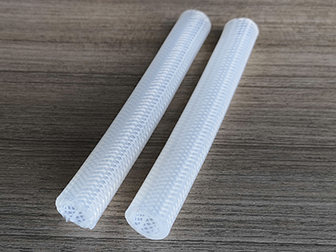
Fiberglass reinforcement is suited to demanding high-temperature and high-boost applications.
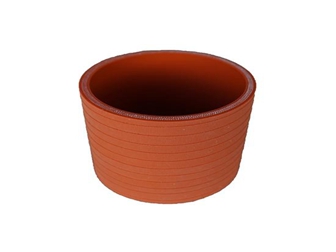
Aramid reinforcement provides high strength for applications where high temperature and boost pressure are combined.
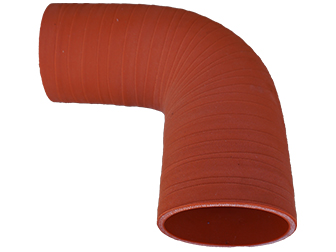
Wire reinforcement serves different structural purposes depending on its design. Steel wire can help resist collapse under vacuum, while steel ring reinforcement can be used where increased burst pressure is required. Wire-reinforced constructions can also be used in high-temperature applications.
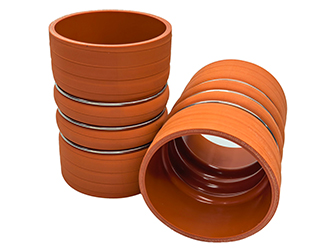
The key is to select reinforcement according to the actual combination of temperature, pressure, vacuum and movement rather than choosing a reinforcement layer based on temperature alone.
Where Are High-Temperature Silicone Hoses Used Around an Engine?
High-temperature hose applications can occur in several parts of an engine system.
Turbocharger and charge-air systems are common examples. These hoses may experience boost pressure, rapid temperature changes and engine movement. The hose also needs to maintain its shape and connection under repeated operating cycles.
Engine intake and air-handling systems may have different requirements depending on airflow, temperature and routing. A flexible construction can be useful when the hose must pass through a confined engine compartment.
Exhaust-related ducting presents another type of thermal challenge. A high temp silicone exhaust hose is used for specialized exhaust-related ducting rather than as a general replacement for every exhaust pipe. SUNRISE offers high-temperature exhaust duct constructions using silicone-coated fiberglass fabric and steel wire reinforcement, with the specific construction depending on the application.
The surrounding environment should also be considered. Even when the air or gas inside the hose is not at the highest temperature, radiant or conducted heat from nearby components can affect the hose wall.
Consider the Medium, Not Just the Temperature
Temperature resistance does not automatically mean that a hose is suitable for every medium.
Air, coolant, fuel, oil and chemicals can impose different material requirements. For example, an application involving oil or fuel contact may require a different inner material from an air or coolant application.
For applications where fuel or chemical resistance is important, a fluorosilicone or FKM liner may be considered depending on the medium and operating conditions. FKM-lined silicone hose constructions can be considered for applications requiring heat, oil and chemical resistance.
This is why hose selection should follow a complete sequence:
Temperature + Medium + Pressure + Mechanical Conditions → Hose Construction
Looking at only one of these factors can result in an incomplete specification.
When Should You Consider Custom Silicone Hoses?
Standard straight hoses are not always suitable for high-temperature engine systems. Limited space, unusual routing, multiple connection points or tight bends can require a more specific geometry.
This is where custom silicone hoses can be relevant to high-temperature engine and exhaust applications.
The customization may involve hose diameter, length, bend angle, shape, reinforcement layers or connection components. Straight, transition and hump styles can be used for reinforced high-temperature constructions, while complex shapes can be manufactured according to specific application requirements.
For a custom project, a drawing or sample can provide important information about the required geometry. The operating temperature, pressure, medium and installation conditions should also be defined because these factors influence the appropriate hose construction.
How to Specify a High-Temperature Hose for Your Project
Before selecting a hose, it is useful to define the following requirements:
Temperature
-
Continuous operating temperature
-
Peak temperature
-
Ambient temperature
Pressure
-
Working pressure
-
Boost pressure
-
Vacuum conditions
Medium
-
Air
-
Coolant
-
Oil or oil mist
-
Fuel
-
Other chemicals
Construction
-
Polyester, fiberglass, aramid or wire reinforcement
-
Required number of reinforcement layers
-
Inner liner when needed
Geometry
-
Inside diameter
-
Outside diameter
-
Wall thickness
-
Length
-
Bend angle and radius
-
Branches or special connection points
Providing these details gives the hose manufacturer a clearer basis for evaluating the construction instead of selecting a product from temperature rating alone.
FAQ
What is the maximum temperature a silicone hose can handle?
There is no single maximum temperature for every silicone hose. The limit depends on the silicone compound, reinforcement, hose construction, pressure, medium and exposure time. For example, SUNRISE lists certain fiberglass reinforced constructions at up to 310°C, while certain aramid reinforced constructions are rated up to approximately 510°F (265°C). These ratings apply to specific hose constructions and should be confirmed against the product data sheet for the intended medium and service conditions.