You will encounter three silicone hose material options: VMQ, fluorosilicone hose (FVMQ), and reinforced silicone hose. VMQ handles general use, fluorosilicone resists fuel and oil, and reinforcement adds pressure strength. This Silicone Hose Material Guide helps you match material to temperature, chemical, and durability needs. Sunrise supplies all three. The silicone hose market reached USD 1.2 billion in 2024 and grows at 6.5% CAGR through 2033.
VMQ silicone handles general uses like coolant and air. It works from -60°C to +230°C. But it fails with fuel and oil.
Fluorosilicone resists fuel, oil, and vapors. It keeps flexibility in cold. Choose it for fuel lines and oil systems.
Reinforced silicone adds strength for high pressure. It meets SAE standards. Use it for turbochargers and heavy-duty cooling.
VMQ, or vinyl methyl silicone, is the standard general-purpose silicone rubber for industrial and automotive hose applications. This silicone hose material serves as the baseline in any Silicone Hose Material Guide because it balances cost, performance, and versatility. Its molecular structure provides exceptional flexibility and environmental stability that few other elastomers can match.
VMQ silicone delivers a continuous service temperature range of –60 °C to +230 °C, with intermittent peaks up to approximately 300 °C tolerable for short periods. This thermal window exceeds most general-purpose rubbers. The material also offers outstanding compression set and resilience, maintaining sealing force under heat and returning to shape after deformation. Key properties include:
|
Property |
Typical Range |
|---|---|
|
Durometer (Shore A) |
20 – 90 |
|
Tensile Strength |
900 – 1,500 psi |
|
Elongation at Break |
100 – 700 % |
|
Continuous Temp Range |
–60 °C to +230 °C |
However, VMQ has one clear limitation that affects your material selection. Its resistance to fuels, oils, and solvents is poor. A silicone hose connected to a PCV line carrying oil vapor absorbs the oil, swells, and then collapses or pulls loose. Diesel fuel and gasoline vapors cause swelling, softening, and vapor loss. VMQ works well with coolant, ozone, UV, and water but cannot handle hydrocarbon fluids.
You find VMQ silicone hoses in coolant systems, air intake lines, water transfer, and general fluid handling without petroleum products present. It excels in radiator hoses and intercooler connections. The material also performs admirably in outdoor environments due to its outstanding weather and UV resistance.
The pros include unmatched temperature range, excellent flexibility, and outstanding ozone resistance. The cons include poor fuel and oil resistance and lower tear strength than HNBR or FKM. Choose VMQ when you need a reliable, cost-effective hose for clean air, coolant, or water applications.
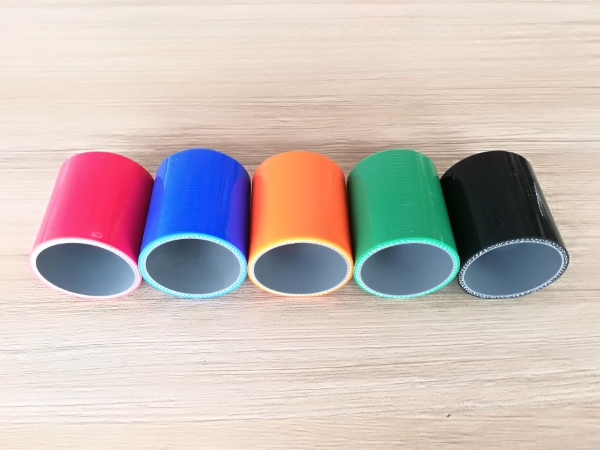
Standard VMQ cannot handle fuels and oils in your system. Fluorosilicone (FVMQ) becomes the right fluorosilicone hose material in those cases. FVMQ carries fluorinated side chains attached to the silicone backbone. This molecular change transforms chemical resistance while preserving thermal flexibility.
Fluorosilicone gains its enhanced chemical resistance through fluorination. This process strengthens molecular bonds in the silicone structure. Trifluoro propyl groups sit adjacent to the methyl groups in FVMQ. This arrangement provides resistance to fuels, chemical attacks, and mineral oil. It also maintains mechanical and physical properties similar to VMQ.
FVMQ is a fluorinated silicone polymer. Its molecular structure has improved stability due to fluorination, which gives it better chemical resistance than standard VMQ.
You can use FVMQ with gasoline, diesel, and oil vapors without the swelling you would see with standard silicone. The continuous temperature range reaches up to +220 °C with an additive package. That additive may narrow low-temperature flexibility. This Silicone Hose Material Guide considers FVMQ the bridge between general-purpose silicone and specialty fluoroelastomers.
You find fluorosilicone hose in high-performance automotive fuel lines, industrial oil return systems, and vapor recovery applications where hydrocarbons are present. The material also handles turbocharger oil drain lines and emission control systems in demanding environments.
Fuel service applications present a choice between FVMQ and FKM liners. FVMQ offers better low-temperature flexibility. It maintains sealing integrity in cold environments. FKM provides superior fuel resistance at high temperatures. However, it becomes brittle in extreme cold. Applications needing both fuel resistance and winter performance favor FVMQ as the stronger candidate.
Pros include excellent fuel and oil resistance, wide temperature range, and good low-temperature flexibility. Cons include higher cost than VMQ and reduced hot-oil resistance compared to FKM.
Reinforced silicone hose embeds one or more support layers inside the silicone wall. Common reinforcement materials include polyester and aramid fibers. Polyester braid suits moderate-pressure coolant and air systems. Aramid reinforcement handles higher mechanical loads found in turbocharger lines. This construction increases burst pressure dramatically compared to unreinforced hose. SAE J20 governs these products. It specifies minimum burst must be 4x working pressure. The standard divides construction into five types for different use cases. Heavy-duty 20R1 hoses use thick walls up to 7.1 mm with reinforced fabric layers, achieving burst pressures exceeding 300 psi. 20R2 hoses embed stainless steel wire helix for crush resistance in vacuum and turbo intercooler lines. 20R4 represents the most widely specified type for passenger car radiator connections, balancing flexibility with pressure rating. Each type delivers a specific mechanical profile for its intended system.
You find these hoses in automotive turbocharger systems, heavy-duty engine coolant circuits, and industrial high-pressure fluid transfer. SAE J20 Class A silicone offers continuous service from -55°C to +175°C. It resists ozone, UV, and glycol-based coolants. Applications extend to HVAC systems, marine engines, and power generation equipment. The reinforced construction resists cracking and peeling under steam exposure while maintaining flexibility. Verify SAE J20 compliance by requesting your supplier's test report. Look for permanent, legible markings that confirm the exact class. This Silicone Hose Material Guide recommends reinforced silicone when your system demands burst resistance above 300 psi or requires compliance with SAE standards. Pros include high pressure ratings, excellent temperature range, and long service life. Cons include higher cost than unreinforced VMQ and reduced flexibility in tight routing. Choose reinforced silicone for demanding pressure and durability requirements.
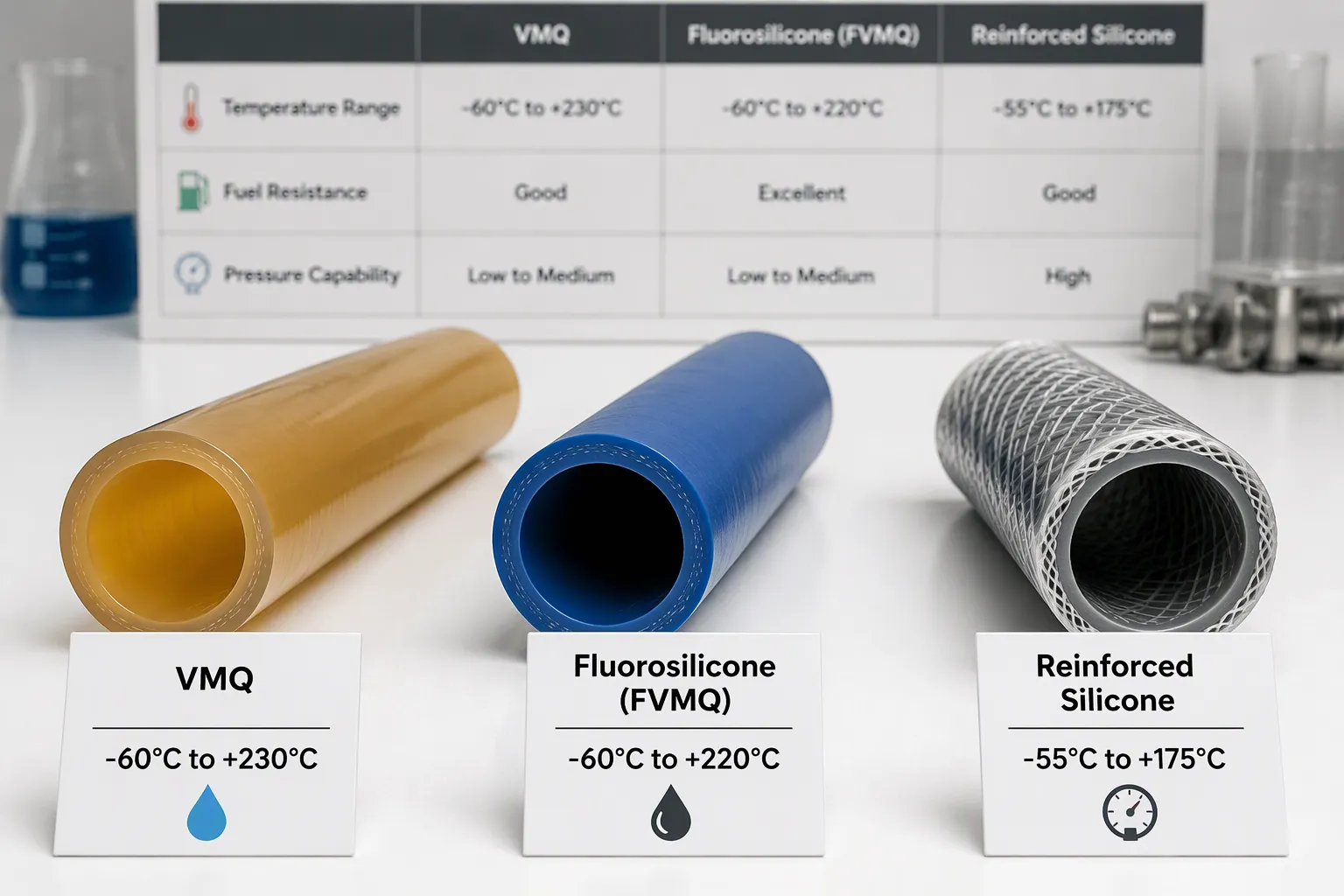
This Silicone Hose Material Guide section provides a direct comparison table and decision framework. You can match VMQ, fluorosilicone, and reinforced silicone to your specific operating conditions using these criteria.
|
Property |
VMQ |
Fluorosilicone (FVMQ) |
Reinforced Silicone |
|---|---|---|---|
|
Continuous Temperature Range |
–60 °C to +230 °C |
–60 °C to +220 °C |
–55 °C to +175 °C |
|
Fuel and Oil Resistance |
Poor |
Excellent |
Dependent on base rubber |
|
Pressure Tolerance |
Low (unreinforced) |
Low to moderate |
High (burst ≥300 psi possible) |
|
Flexibility |
Excellent |
Good |
Moderate |
|
Relative Cost |
Low |
Moderate |
High |
Each material trades one attribute for another. VMQ delivers the widest thermal window but cannot handle hydrocarbons. FVMQ sacrifices a small portion of that temperature range to gain robust chemical resistance against gasoline, diesel, and oil vapors. Reinforced silicone reduces flexibility to achieve mechanical strength that unreinforced materials cannot reach. Aramid reinforcement layers enable burst pressures exceeding 300 psi under SAE J20R3 specifications. This practical Silicone Hose Material Guide comparison reveals a clear progression: VMQ as your baseline, FVMQ for chemical resistance, and reinforced silicone for pressure demands.
Your primary challenge determines the starting point. For coolant circuits, air intake systems, or water transfer without petroleum exposure, VMQ delivers the most cost-effective solution with its full temperature range and excellent flexibility. For fuel lines, oil return systems, or vapor recovery applications where hydrocarbons contact the hose wall, FVMQ becomes the correct selection.
Pressure requirements drive your choice toward reinforced silicone. Wall thickness directly governs pressure resistance. Thicker walls support higher pressure ratings. Insufficient thickness causes ballooning, collapse, or burst under load. Reinforcement layer count scales with required pressure:
Unreinforced plain wall for low pressure below 50 PSI.
Braid-reinforced construction for medium-to-high pressure applications.
Mandrel-wrapped 4-ply for the highest pressure ratings.
For negative-pressure vacuum circuits: specify 60–70 Shore A hardness with minimum 3-ply reinforcement to prevent collapse.
For positive-pressure intercooler plumbing up to 0.25 MPa: use 4-ply reinforcement with 55 Shore A hardness for optimal flexibility and strength.
Over 80% of customers consider material quality as the most critical factor when selecting a silicone hose material, according to a recent industry report.
That statistic reinforces a simple truth: you cannot compensate for the wrong base polymer with thicker walls or additional reinforcement layers. Choose the base compound first to match your chemical and thermal environment, then specify reinforcement for pressure requirements.
Sunrise supplies all three material options and provides custom hose solutions for unique applications. Consult their engineering team when your system demands a specific combination of temperature resistance, chemical compatibility, and pressure rating. Their expertise ensures you select the right construction for each circuit in your system.
Choose VMQ for general applications. Select fluorosilicone hose for fuel and oil environments. Use reinforced silicone hose where high strength matters. Evaluate temperature range, chemical exposure, pressure tolerance, and flexibility needs. This Silicone Hose Material Guide streamlines your selection process. Contact Sunrise for custom solutions. Proper material matching ensures safety and peak performance.
Choose fluorosilicone hose when fuel, oil, or vapor contacts the hose wall. VMQ swells and softens in hydrocarbons. FVMQ resists gasoline, diesel, and oil while keeping good low-temperature flexibility.
No. Reinforcement raises burst strength, but wall thickness and layer count set the real limit. Specify reinforced silicone hose when your system needs burst resistance above 300 psi or SAE J20 compliance.
VMQ covers –60 °C to +230 °C, the widest window of the three. FVMQ reaches +220 °C with an additive. Reinforced silicone serves –55 °C to +175 °C. Match your silicone hose material to the hottest and coldest points in your system.

Sunrise Silicone Hose Co., Limited


عنوان : Suite 805, No. 341 Jiahe Road, Xiamen City, Fujian Province, China
بريد الالكتروني : sales@siliconehose-china.com